Rust and salt air: what the lagoon and the ocean do to a garage door, and how to slow it down
The Treasure Coast has a 150-mile estuary on one side and the Atlantic on the other, and the prevailing east wind carries salt from both well inland. A garage door is a steel machine with forty moving parts sitting in that air. Here is where it rusts first, what it means for safety, and the routine that gets a door through its full life anyway.
Where the rust starts
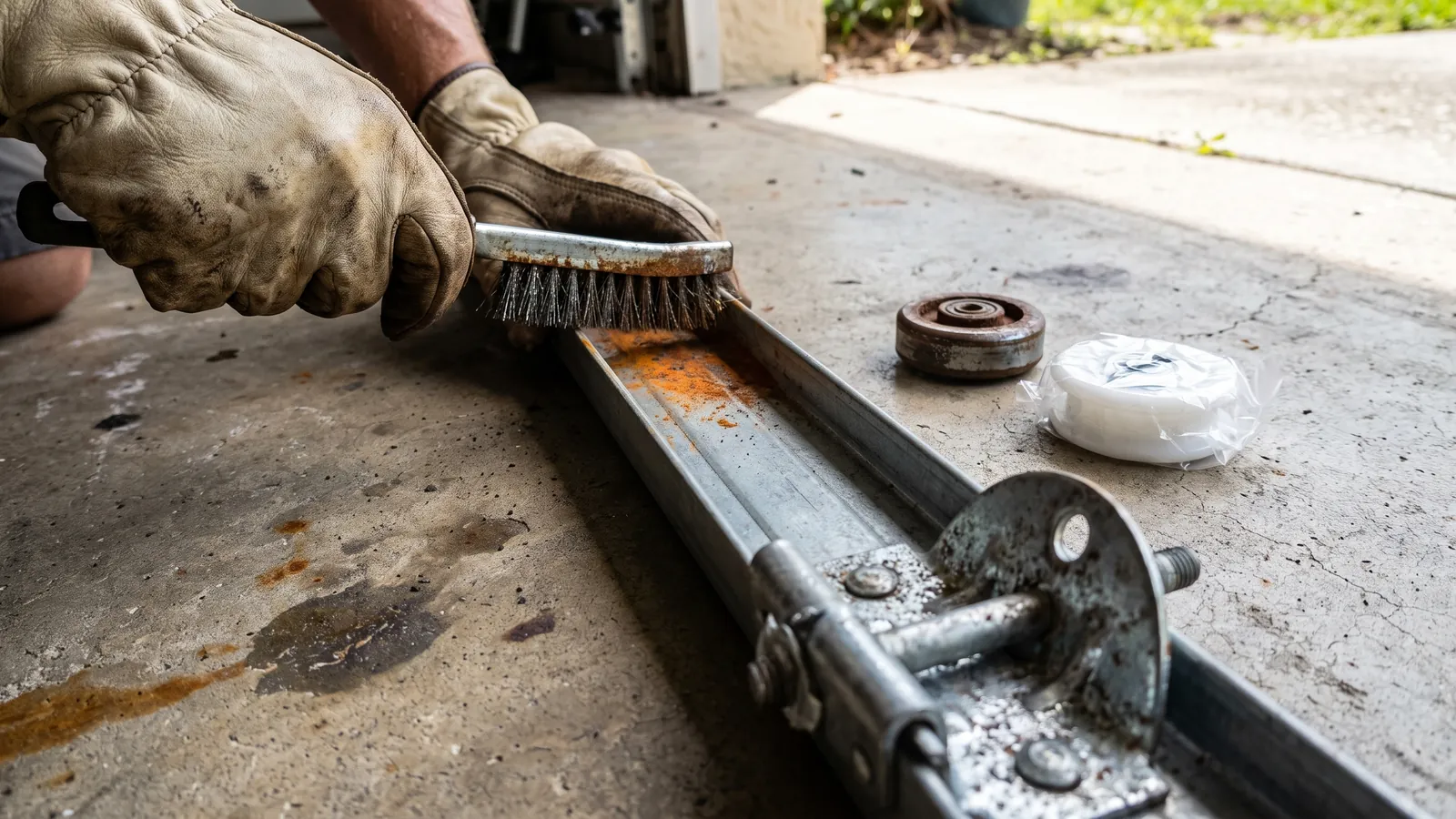
Bottom brackets and cable ends. The lowest hardware on the door collects every splash from the driveway and every damp night, and the lift cable wraps around the bracket's pin. Rust there is the usual cause of a snapped cable on a waterfront door, and because the bracket is under full spring tension it is the one rusty part a homeowner should never touch. Spring coils. Oil-tempered steel pits in salt air; a pitted coil concentrates stress and the spring breaks well short of its cycle rating. Roller bearings and hinges. Unsealed steel rollers seize, the hinges crack trying to drag them, and the door starts shuddering. The bottom section. Water wicks under the bottom seal into the section's lower edge and rusts the skin from the inside, showing as bubbling paint a year before it shows as holes. Track and fasteners. Galvanized track lasts; the uncoated lag bolts and hinge screws holding it often do not.
How far in it reaches
There is no sharp line, but the pattern across the service area is consistent. Doors on Hutchinson Island, in Jensen Beach, Rio, Sewall's Point, along the Stuart and Fort Pierce waterfronts and near the Intracoastal in Hobe Sound show salt damage within a few years. Doors a mile or two inland, in most of Port St. Lucie east of the Turnpike and in Palm City near the river, show it slowly. Tradition, Verano and the western plats see little salt and their doors fail from cycle count and heat instead.
A rhythm that works
| How often | Within about a mile of salt water | Further inland |
|---|---|---|
| Monthly | Rinse the outside of the door, the bottom section edge and the lowest two feet of track with fresh water; wipe the photo-eyes | Wipe the photo-eyes; look at the bottom edge |
| Every three months | Garage door spray on spring coils, hinges and roller bearings; check the bottom seal | Every six months |
| Yearly | Technician tune-up with rust treatment, cable and bracket inspection, balance and reverse test | Technician tune-up |
| At replacement | Galvanized or coated springs, galvanized cables and brackets, sealed nylon rollers, stainless fasteners | Standard parts, nylon rollers |
What to use and what to avoid
A silicone or white lithium spray sold for garage doors, applied lightly, is right for coils, hinges and bearings. Do not use a penetrating solvent as a lubricant; it strips the little grease the part had and leaves bare steel to the salt. Do not grease the inside of the track; rollers should run on clean, dry track, and grease there collects grit. Rinse with fresh water, not a pressure washer, which drives water into the section seams.
Parts that shrug off the salt
Galvanized or powder-coated torsion springs add $40 to $90 a pair. Galvanized cables and bottom brackets are $210 to $440 together and are the single most important upgrade on a waterfront door. Sealed-bearing nylon rollers, $160 to $280 for a set of ten, never seize. When the door itself is being replaced, a steel door with a baked-on finish and a galvanized skin is standard; aluminum, fiberglass-skinned and vinyl doors are options for the most exposed lots, each with trade-offs in weight and wind rating the technician can walk through.
When rust means a new door
Surface rust on hardware is maintenance. Rust through the bottom section, a cable bracket that has lost metal, or rust where a strut meets the section means the door's structure is compromised and its wind rating, if it ever had one, is gone. At that point a repair buys a year and a replacement rated for the site is the sounder spend, with the grant and the insurance credit easing the cost.
Questions on this subject
Is bubbling paint along the bottom of the door serious?
It is the early sign of the bottom section rusting from the inside. Caught early, a new bottom section at $450 to $850 fixes it; left two more summers, the whole door is usually due.
Can rusty springs be cleaned and saved?
Light surface rust can be brushed and lubricated and the spring will carry on. Pitting, where you can feel roughness in the coil, means the spring is weakened and will break early; replacement with a coated spring is the safe choice.
My cables look rusty. Can I replace them myself?
No. The cables are under full spring tension at the bottom bracket. A technician releases the tension, swaps cables and brackets as a set and rebalances the door, $210 to $440, usually in an hour.
Will a tune-up help a door that is already rusty?
Yes. Rust treatment on springs, brackets and track, lubrication and a bracket inspection, $80 to $160 on top of the tune-up, slows the damage and catches a cable before it lets go.
Does an insulated door rust less?
Not by itself, but the better three-layer doors have a baked-on finish, galvanized skins and a bottom section designed to shed water, and they hold up better than the single-layer builder doors of the 1990s.
Keep reading: Tune-ups and rust care · Spring replacement cost · Jensen Beach · Repair it or replace it