The garage door will not close: eight checks in order, and the one where you stop
A door that goes down a foot and comes back up, or just blinks its light and sits there, is almost always one of a handful of things, and most of them you can check in ten minutes without a tool. Here they are in the order a technician would go through them, with the point at which the job stops being yours.
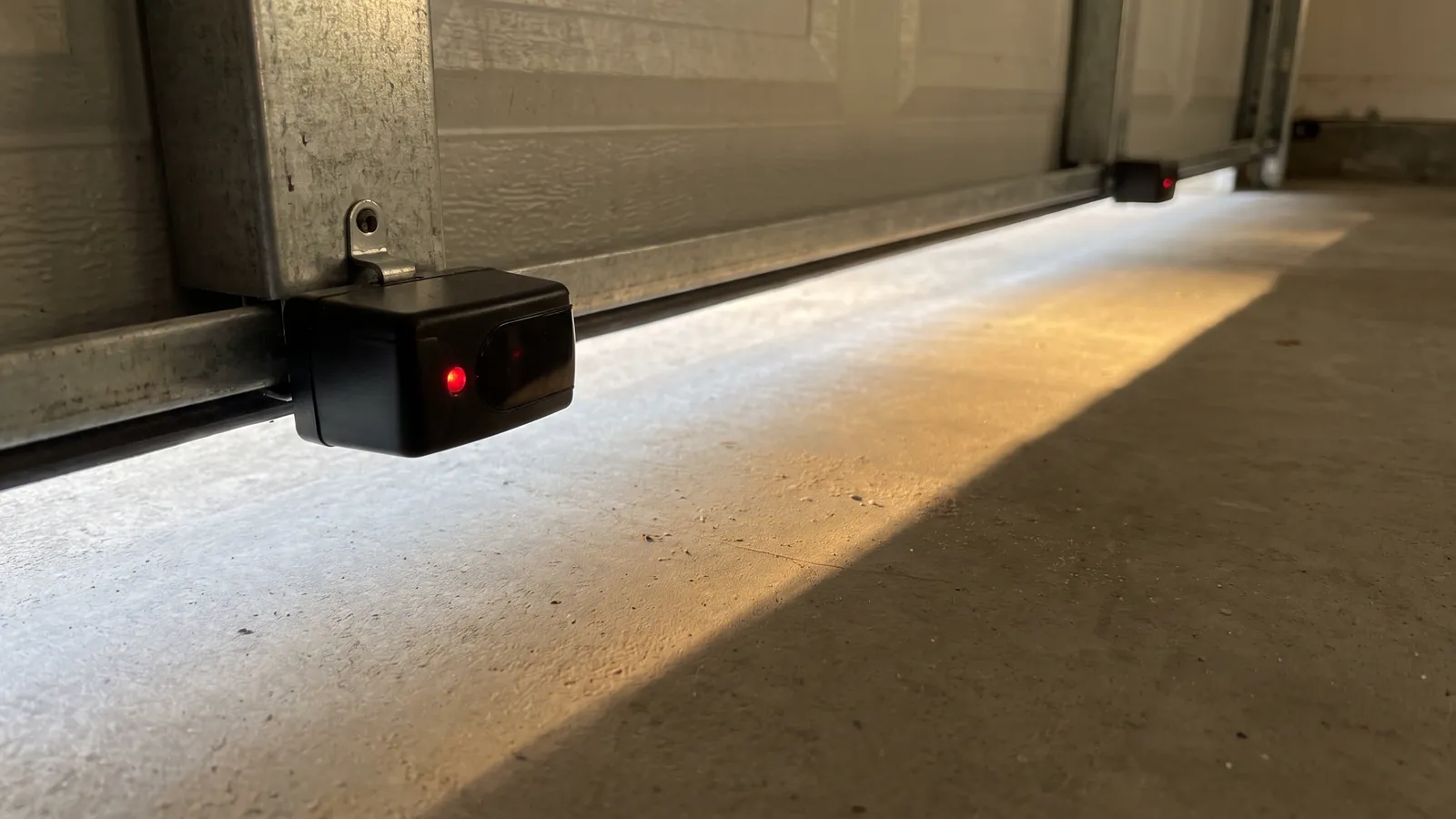
Look at the two small lights
The photo-eyes sit on each side of the door about six inches off the floor. Each has an indicator. Both steady: the eyes are fine, go to step 4. One off or flickering: that eye is out of line or blocked. Wipe both lenses with a dry cloth, look for a spider web, a leaf, a bike tire or a trash can in the beam, then loosen the wing nut on the flickering eye, swivel it slowly until the light holds, and tighten.
Notice the time of day
If the door misbehaves only in the late afternoon and the garage faces west, the sun is shining straight into the receiving eye and overpowering the beam. Shade it with your hand and press the button; if the door closes, that is your answer. A sun shield, swapping the sender and receiver sides, or a newer sensor pair fixes it for good, $60 to $120.
Hold the wall button down
On most openers, pressing and holding the wall button until the door reaches the floor bypasses the photo-eyes. If the door closes while you hold it, the opener and the door are fine and the problem is the eyes or their wiring. If it still reverses, the problem is mechanical, so skip to step 6.
Check for lock mode
Many wall consoles have a lock or vacation switch that disables remotes while the wall button still works. If the remotes do nothing but the wall button closes the door, that switch has been nudged, usually by a broom handle.
Look at the travel limit
If the door reaches the floor and then immediately reverses, the opener thinks it has hit something because its down limit is set a fraction too far. A door that stops an inch short has the opposite problem. The adjustment is a dial or a button on the motor head and the manual shows which; a quarter turn at a time, then test. If you are not comfortable, this is a trip-fee-only visit at $79 to $129.
Listen and watch for binding
With the door moving, does it shudder or hesitate at the same spot every time, or does a section flex? A roller riding out of the track, a cracked hinge, a bent track from a bumper tap or a dry roller bearing will make the opener sense resistance and reverse. Lubricate rollers and hinges with a garage door spray; if the hesitation stays, the hardware needs a technician.
Do not raise the close force
The force setting tells the opener how much resistance means an obstruction. Turning it up to push through a binding door is how doors crush things and how openers strip gears. Leave it where it is and fix what is binding.
Stop here if the door is heavy
Unplug the opener, pull the red release with the door down, and lift the door by hand. It should rise with one hand and stay put at waist height. If it is heavy, drifts down, or a cable is slack, the spring or a cable has gone. Plug the opener back in, leave the door alone and call. Nothing from here on is safe to do yourself.
What it usually turns out to be
Across a year of calls on the Treasure Coast the order looks roughly like this: photo-eyes knocked out of line or blinded by sun, then travel limits drifting on an older opener, then rollers and hinges that have never seen lubricant, then a cable fraying at a rusted bottom bracket, then a spring that has lost tension without breaking outright. The first two are cheap. The last two are why the door should be lifted by hand before anyone talks about the opener.
What it costs when you do call
Realignment, a limit adjustment or a lock-switch surprise is normally the $79 to $129 trip fee and nothing else. A sun shield or a new sensor pair is $60 to $200. Rollers and hinges run $160 to $280 for a full set. A cable with brackets is $210 to $440, and a spring pair $320 to $560. All of it is quoted at the house before any work starts, and most of it is finished the same visit.
Questions on this subject
The door closes from the wall button but not the remote. Why?
Lock mode on the wall console, a dead remote battery, or a remote that has lost its pairing after a power blip. Check the switch first, then the battery, then re-pair the remote following the opener's manual.
Both sensor lights are off. What now?
Power or wiring. Check that the opener itself has power and that the thin sensor wires are intact where they staple along the wall and the rail; rodents and weed trimmers both find them. If the wires look fine, the opener's sensor circuit may have failed, which is a technician's job.
Can I just unhook the sensors so the door closes?
No. The eyes are a required safety feature on every opener made since 1993 and a door that closes blind can injure a child or a pet. Fix the eyes; it is one of the cheapest repairs there is.
The door closes, then opens again by itself a minute later. What is that?
Usually a sticking wall button, a remote with a stuck button somewhere in a car or a drawer, or a neighbor's remote on an old fixed-code opener. Unplug each suspect in turn. If it persists on a 1990s opener, that is a reason to replace it.
Why does it only happen when it rains?
Water finding its way into a sensor housing or a splice in the sensor wiring, or a swollen wooden jamb pressing on the track. The first is a wiring repair at $95 to $180; the second needs the jamb trimmed or the track shimmed.
Keep reading: Safety sensor repair · Opener repair · Cable, track and roller repair · Emergency repair